Daughters of Tith
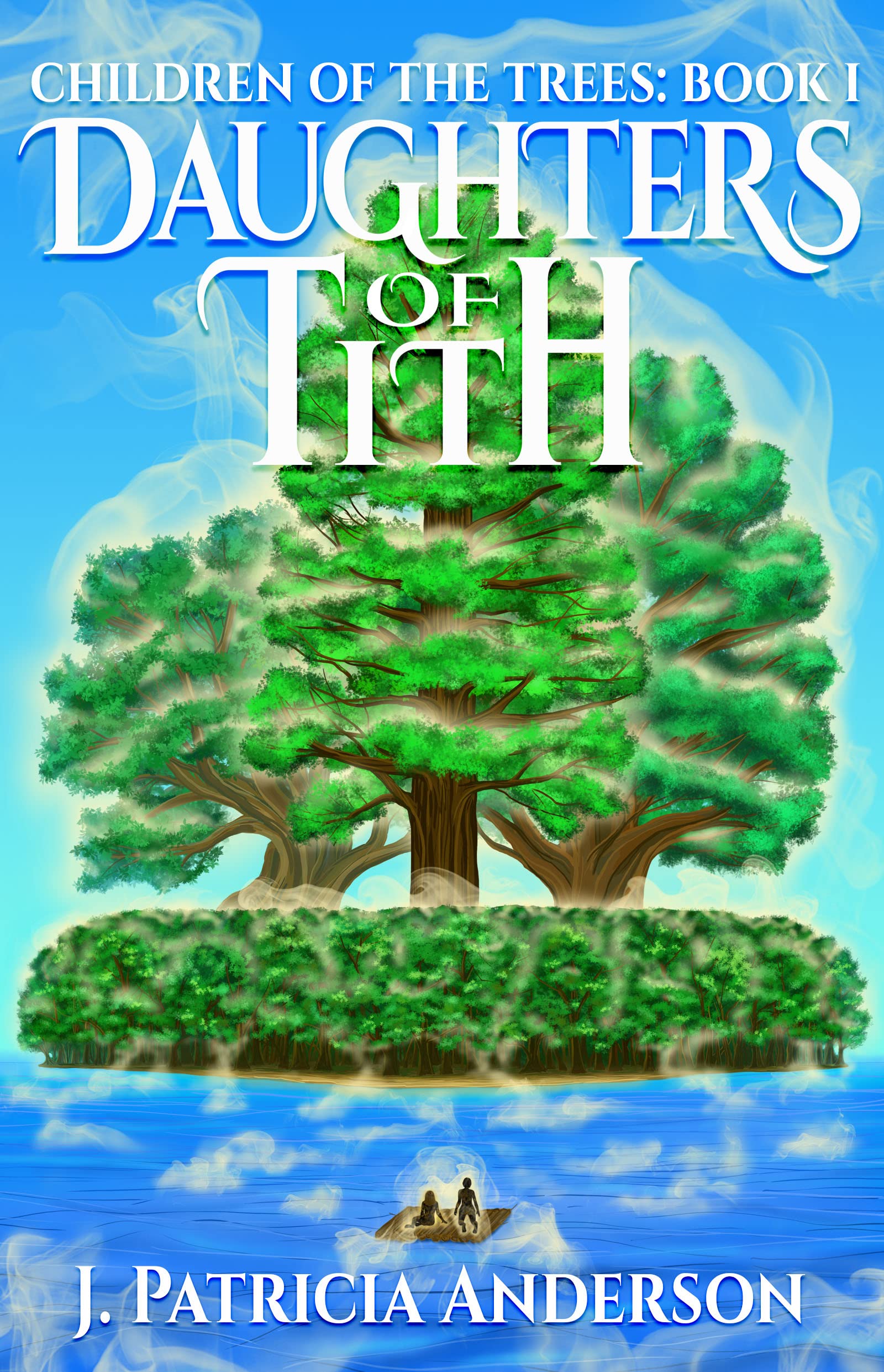 Series: Children of the Trees, #1
Author: J. Patricia Anderson
Genre: Fantasy
Book Description:
The kandar are the children of the trees. Powerful. Immutable. Nine hundred eternal beings who need no sleep nor sustenance, created at the beginning of time to guard the nine human Earths.
That was never meant to change.
The youngest of five sisters, Tchardin is about to be acknowledged as queen of the kandar. She must lead them in their Creator-given Purpose–to guide and inspire the humans–but her people have been exiled to their homeworld for generations. None of them have seen the Earths. Not one of them has met a human.
Tchardin can think of no way to end their exile until a strange longing calls her from beyond the shore of their island. Most of her sisters tell her to ignore it, to take her place as queen and focus on the kandar. One suggests she answer it, as it might be the key to finally returning her people to their Purpose.
Book Review:
Daughters of Tith is a big, complicated book, but it was easy to read and engaging. The world-building was intricate and well-detailed, and sometimes wild and strange, the magic was cool, and I found the characters to be deep and feel real – even if at first many of them are very inhuman and, well, don’t yet have a lot of character.
I liked many of the kandar. Tchardin was interesting to get to know, as she’s very inexperienced, and very dedicated to something that she doesn’t really even have an idea of – only she’s been told it’s her duty. And she fully intends to try with everything she is, even if she regularly tries to avoid her sister’s lessons, which seem meaningless to her. The way the things she doesn’t understand, and most of the other kandar don’t either, and the things they take as a given was handled was very well-done and made things quite interesting.
But while Tchardin is very inexperienced, with little true knowledge, she does have more knowledge and personality than most of the kandar, and there was a lot I liked about her even from the beginning. There was no one to attend her birth – her emergence from her father-tree – and so now she makes sure to go to all the new births for all the kandar. At times, her certainty of her purpose and right as queen might seem a little arrogant, yet it did not seem that way to me at all – it is all she knows, a given presented to her from the beginning of her memory, something too in-built to be questioned or noticed, but it is clear that she values all the kandar and cares for them in the only ways she knows – or has been told – how.
So, while it’s quite interesting watching all the kandar develop their personalities, and by the end there’s a great deal of complexity in their societies and personalities, I particularly enjoyed watching Tchardin develop as she journeys through the human Earths. There’s a simplicity, an innocence, and a kindness to her, one that grows in a way as she has experiences, and sees pain, and joy, love and hate, but she also comes in the end to question so much she’s been told. Perhaps my favorite part was an interaction she has with a very few kind humans on one of the Earths, one of whom many could consider “stupid,” who do a great thing for their world – as ordinary people who simply see the good and hope in life.
The other kandar were also interesting to watch. All her sisters have unique personalities and interests, and the story eventually becomes quite complicated, as conflict comes to the rapidly-developed kandar. Different kandar choose different paths, to the great sorrow of some. There are also a lot of twists and rapid developments and high tension.
I also enjoyed Cien, another kandar. He’s made his own path to be different and unique almost from the first, on his own, and I liked him a lot. However, I found his personality and character arc to be at times a bit too much of what I think I’d call the ‘tortured, self-sacrificing man.’ Not in a bad way, really. I have mixed feelings even about this. It certainly does not clash badly. It just … I’m not truly sure why it was there. So many books have it, and I’m not sure why this one does.
But while the world-building, and the trees, and the characters, and the story were all quite interesting, there are a few things that make me very uneasy about it. The context of the ‘Creator’ and the human earths felt like it was supposed to be too much like certain real-world beliefs in a way that made me very uncomfortable. I also have mixed feelings about the human power to create things and the extent to which they make their worlds. The tie or combinations between both of those things was disturbing.
I also found the way that damaged kandarin trees were handled disturbing. If they are damaged in any way, they always go insane and have to be killed so that the kandar who go to rest in them don’t come out insane, and I don’t enjoy the implications in that. The trees seem to be people, too, and so they should get to make choices, to heal and grow. There’s beauty in a tree surmounting challenges and healing, and this seemed stagnant and wrong. Also, you shouldn’t kill people like that! So I didn’t enjoy how that was handled – though there was something else that made balance it a little, as it seems that someone’s need/want is able to work magic of its own, do things the kandar consider impossible, and even heal damaged trees.
I’m also not sure what the thing going on with the kandar going to rest and being re-born is. Are they the same souls, the same people really? It seems often they are not. They’re the same bodies, and if a body is lost that’s it … or is it? It seems things might be more complicated than that. But it seems very confusing whether they expect they are the same souls, or whether maybe their souls all go on to something else. But I also found it strange how they make the assumption it’s better for a kandar not to be reborn if they don’t have a dodenzinn, when only some of them choose this. Why is it the preferential decision, in cases where they can’t discover what the kandar would have wanted if they could say?
But perhaps the story is meant to provoke such questions or conversations?
Though it remains to be seen how any of it works out. The story does not end on a cliff-hanger per se, and it could almost be considered standalone (it does not leave you hanging on the next book to find out what happens) but it ends with a great grief, and much that’s forever lost.
 Enthralled By Love