Silver Fire
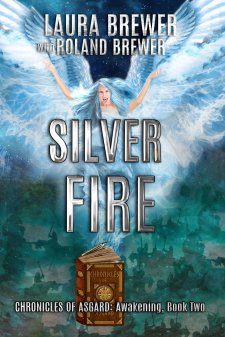 Series: Chronicles of Asgard: Awakening, #2
Author: Laura Brewer, Roland Brewer
Genre: Fantasy
Book Description:
Rowan and Alvinari’s smooth routine is shattered by hordes of mordkii, larger and far better equipped than any they’ve ever seen, approach their borders. Rowan calls up every fighter and mage across the kingdom. Odin musters Asgard, but they are still horribly outnumbered.They block the advance, but when Alvinari breaks her spear, the replacement she’s given bursts into flame – and so does she. Her fire incinerates the enemies she’s facing – and almost consumes her friends.
Hel has just begun to stir wars across the land and on the sea, unleashing demons. No place is safe.
Review:
Note: this review contains spoilers for book one, Winds of Chaos.
Silver Fire contains the story from Winds of Chaos, following the lives of the couple Rowan and Alvinari. However, this one includes more perspectives, notably introducing the goddess Freya as a new major character, with many point of view passages alongside the main couple. Freya, and the other gods as well, are more directly involved and present in this book, and they quickly feel like real characters, very much like the mortals, with quirks and even flaws. In fact, sometimes when they’re relating with the other characters, I almost forgot they were gods. Which fits in very well with something that happens later on.
The story continues to have large cozy places and slice-of-life themes, even as the epic stakes escalate, something I really enjoyed, as we get to see the characters living their lives and having children, as well as discovering new things about themselves. At the same time, the tension does escalate, and there are quite a few battles in this one, alongside the ordinary hunting expeditions. The game-like vibes of the magic, armor, and weapons definitely continue to be a part of both of these, and there are a number of very neat touches related to the Norse/Viking mythology elements.
As I hoped, this book continues to explore the effects of the changes to Rowan and Alvinari’s gender changes. I can’t say it fully satisfied me or turned out to be everything I’d hoped it could be, but it had its moments I enjoyed. What especially stood out to me was the way they’re able to sympathize with each other, and understand where their mate is coming from better, because of their experiences having been the other gender from what they are now. You see it when Alvinari is pregnant and giving birth, when they’re dealing with young children, on the battlefield, and so forth. You see it on both Rowan’s and Alvinari’s sides, and I was really happy with that touch. It’s really amusing from Rowan’s side, when Alvinari is pregnant and giving birth, how he’s actually less worried and more confident.
I also really enjoying the way the details of everyday life – including the ones pertinent to this being a magical world among aspects of things like being parents and having children that aren’t so fantastical – are present alongside the details – not overly gory, but the overviews – of the battles and hunting and more violent and even horrifying scenes. I personally found there to be too much description of the battles and I was getting bored of it before the end. However, Laura does a really good job writing even the most horrifying parts in a way that isn’t at all graphic, though I continue to find there are moments when I feel like the emotions are skimmed over just a little too quickly, though I can understand how it could be difficult to go further into them without touching on details I wouldn’t want to see.
However, I really didn’t like how some of the characters are encouraged to have children, and I didn’t like the approach to raising children to be something the gods and the characters want and see as fitting, as if children are things to be formed and molded. As if one chooses to have and take care of children so the children can serve an end, instead of for the children themselves.
Another thing I’m finding I don’t enjoy is how direct the “chain of command” is. It seems to leave little room for ambiguity and nuance in various places, though on reflection it isn’t clear whether the gods always understand the Creator perfectly. But the implication tends to be that they almost always understand the Creator’s plans pretty well and obey them fairly well, also. All said and done, when finished, when the gods and the human kings and the way their authority to rule and govern is set up, I found both that it reminded me of popes and bishops and priests, and also that I didn’t like how little room for uncertainty it leaves. This was present in Winds of Chaos but it comes out more in Silver Fire.
Alvinari was especially fun in this book. What she discovers about herself, the new powers she gains and the way dealing with them forces her to develop – I enjoyed all of that quite a lot. Though she can be a bit too far out there on the vengeful side. However, the dynamic between her and Rowan continues to be fun, and I did very much enjoy her new powers.
I also particularly enjoyed the way Rowan’s and other’s weapons are blessed and they are led when fighting the demons. In general, I thought the war was well-done as well. The injunction to kill everything, except the people designated to be rescued, put me off a little at first as I thought, “The poor animals! They shouldn’t have to be killed because of the evil these humans are doing!” but then later the characters capture and re-train horses from the enemy, and have a laugh about how they are treating the animals so much better the horses would probably refuse to let their previous owners touch them, so I’m not sure it was about that at all. It seemed to be more about killing non-combatants, and while in general I don’t go for that (in general, I don’t go for war), killing non-combatants who are active participants in child torture and murder might be a different story. In fact, the protagonists don’t commit genocide, and end up rescuing a lot of people, some of them captives and slaves from other cultures, but plenty of them from the oppressive, enemy kingdom as well. People who didn’t embrace the evil, even if they thought they were too helpless to do anything, as well as people who stood against it to varying degrees.
Another thing that stood out I enjoyed was some of the conversations between the gods and the main characters about the importance of not accidentally using their powers to take away other people’s independence or self-sufficiency, or letting other people rely on them instead of making their own choices and doing things for themselves. This is a theme throughout the book, as there are also conversations with the new-comers from an oppressive society about how they’re going to be taught a lot of new skills, including weapons training, so that they don’t have to rely on others to protect them, and how they would never have ended up in the situation of oppressive they had been in, if everyone, including the women and children, knew how and went to fight.
 Enthralled By Love